How to Get More 5-Star Reviews for Your Daycare (Without Being Pushy)
Proven strategies to get more positive reviews for your daycare center. Learn ethical, effective ways to build your online reputation.
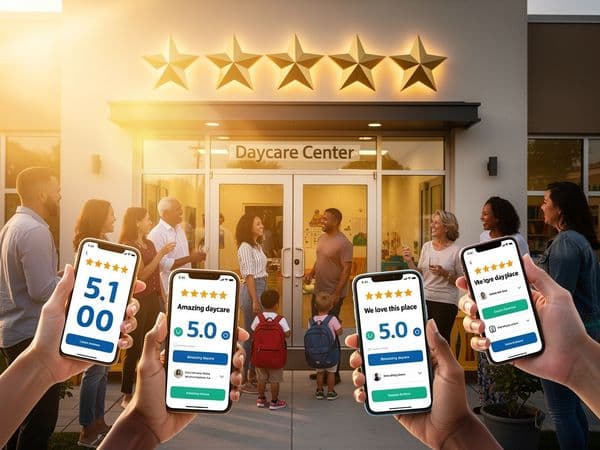
How to Get More 5-Star Reviews for Your Daycare (Without Being Pushy)
As a daycare director or owner, you know that your reputation is everything. You spend countless hours perfecting your curriculum, training your staff, and ensuring safety protocols are met. Yet, one small detail can make or break your enrollment numbers: your online reviews.
Many directors hesitate to ask for reviews because they worry about coming across as desperate or pushy. They worry about the awkwardness of handing a parent a survey while the child is screaming for attention. However, the most successful childcare centers in 2026 understand that asking for feedback is not just a marketing tactic; it is a gesture of care. It shows parents that you value their opinion and want to improve for their child.
In this guide, we will walk through the psychology of reviews, seven ethical strategies to gather them, and the exact scripts you can use to ask without feeling uncomfortable.
Why Reviews Are the #1 Trust Signal for Parents
Before we dive into the "how," we must understand the "why." In the modern childcare landscape, parents are researchers. They do not simply drive by a building and sign up. They start their journey on Google, Yelp, and social media platforms.
According to recent industry data, 92% of parents read online reviews before visiting a childcare facility. Furthermore, 88% of parents trust online reviews as much as personal recommendations from friends.
Consider the math. If your competitor has 4.8 stars with 50 reviews, and you have 3.9 stars with 2 reviews, the choice is obvious to the parent, even if your quality of care is superior. A single negative experience shared online can cost you an enrollment worth between $5,000 and $8,000 per child, per year. Conversely, a steady stream of 5-star reviews acts as a 24/7 salesperson, building trust before the first phone call is ever made.
Reviews are the primary way you demonstrate social proof. They validate your claims. When you say you are "loving and nurturing," a review from a parent saying, "My daughter cries less since coming here because she loves her teachers," carries significantly more weight.
The Psychology of Reviews (When Parents Write Them, What They Say)
To get more reviews, you must understand when a parent feels most compelled to write one. You cannot ask a parent in the middle of a stressful drop-off. Timing is everything.
The Optimal Moments
* The First Week Success: When a child transitions successfully from crying to smiling in the first week, parents feel immense relief. * Milestones: First potty training success, first recital, or mastering a new developmental skill. * End of Semester: When parents see the progress report, they feel satisfied with the investment. * Staff Appreciation: When a specific teacher has gone above and beyond to comfort a sick child or manage a difficult behavior.What Parents Actually Write
Do not expect parents to write essays about your curriculum philosophy. They write about emotions and logistics. Common phrases in 5-star reviews include: * "The teachers are like a second mom." * "I feel safe when I leave my child here." * "Communication is excellent; I get daily photos." * "The food is healthy and my kid actually eats it." * "The pricing is transparent with no hidden fees."By understanding these triggers, you can gently nudge parents to share their experiences when their satisfaction is at its peak.
7 Ethical Ways to Get More Reviews
There is a fine line between asking for feedback and demanding five stars. The following strategies focus on making the process easy and rewarding for the parent, without violating Google's Terms of Service regarding incentivized reviews.
1. The QR Code Check-Out Card
Create a small, high-quality card (like a business card) that sits on the pickup desk. It should feature a QR code that links directly to your Google Business Profile review page. * Cost: Approximately $25 for 100 cards via Vistaprint. * Why it works: It removes the friction of typing a URL. Parents can scan it with their phone while waiting for their child.2. The Post-First-Week Email
Automate an email sequence that triggers seven days after a new child enrolls. If the child has settled in, send a "How are we doing?" email. * Cost: Free (using Mailchimp or Constant Contact). * Why it works: The emotional bond is fresh.3. The Text Message Nudge
For parents who prefer text, a short message is often more effective than email. Send this via your SMS platform on a Friday afternoon. * Cost: $0.01 per message (standard SMS rates). * Why it works: Text messages have a 98% open rate compared to 20% for email.4. The Birthday Month Follow-Up
Send a personalized note on the child's birthday month. Acknowledge the milestone and ask if they enjoyed the celebration. * Cost: $50 in monthly gift cards for the child (optional). * Why it works: It builds a personal connection, making the ask for a review feel like part of a relationship.5. The Newsletter Footer
Add a simple, non-intrusive line at the bottom of your monthly parent newsletter. "Love our center? Let other parents know by leaving a quick review!" * Cost: Free. * Why it works: It keeps the request visible without being aggressive.6. The Open House Booth
During fall or spring open houses, have a "Review Station." It doesn't need to be loud. Just a tablet on a stand where parents can leave feedback if they wish. * Cost: Tablet stand ($20) + Wi-Fi. * Why it works: Parents are already in a community mindset during events.7. The Director's Personal Touch
Once a quarter, the director should personally email the top 20 most engaged parents (those who volunteer or attend events). * Cost: Time only. * Why it works: People rarely say no to a personal request from a leader they respect.How to Ask Without Being Awkward (Scripts and Templates)
The biggest barrier for directors is the fear of rejection or awkwardness. Use these exact scripts to remove the guesswork.
In-Person Script (During Pickup)
"Hi Sarah! I noticed Leo had such a great time during art class today. We are trying to improve our online presence to help other parents find us. Would you be open to sharing a few words about your experience on Google? It would mean the world to our staff."Subject: How is [Child's Name] doing?Why this works: It focuses on the child's experience first, not the review.
Email Template
> Dear [Parent Name], >
I hope you are having a wonderful week! I was thinking about [Child's Name] and the progress [he/she] has made with [specific skill] this month. We are so proud to be a part of [Child's Name]'s journey.>
We are currently working on helping more families in our community find us. If you have a moment, could you share your experience on Google? It takes less than two minutes.>
[Link to Review Page]>
Thank you for trusting us with your family.>
Warmly,
[Your Name]
[Daycare Name] DirectorText Message Template
Hi [Parent Name]! It's [Your Name] from [Daycare Name]. We loved having [Child's Name] today. If you have a spare moment, would you mind sharing a quick review on Google? It helps us reach more families. Thanks so much! [Link]Do not respond immediately. Wait at least two hours. Emotions run high, and you want to respond professionally, not defensively.What to Do With Negative Reviews (Step-by-Step Response Guide)
Not every review will be five stars. In fact, if you never have a negative review, you might not be operating authentically. How you handle the bad ones matters more than the good ones.
Step 1: Pause and Breathe
Step 2: Verify the Facts
Check your logs, camera footage, or staff reports to understand what happened. Ensure the reviewer is actually a current or past parent.Step 3: Draft a Public Response
Your public response is for other parents reading the review, not just the reviewer. Acknowledge the concern, apologize for the experience, and take it offline.Example Negative Review Response:
"Hello [Parent Name], thank you for bringing this to our attention. We are sorry to hear that you felt your concerns were not addressed. Safety and communication are our top priorities. We would appreciate the opportunity to discuss this further to resolve the issue. Please call me directly at [Phone Number] so we can make this right."Contact the parent via phone or email. Listen without interrupting. Often, a resolved issue leads to a deleted review or an updated 5-star review.Step 4: Move to Private Communication
Step 5: Learn and Adapt
If the review highlights a recurring issue (e.g., "staff is always late"), address the operational problem internally.Review Management Tools and Systems
While you can manage reviews manually, scaling is difficult as your center grows. Here are the tools used by top daycare centers to automate the process.
| Tool | Best For | Estimated Cost | Features | | :--- | :--- | :--- | :--- | | Google Business Profile | Basic Management | Free | Direct link to reviews, basic insights. | | Podium | SMS Collection | $250 - $400/mo | Text-to-review, inbox management. | | Birdeye | Multi-location | $300 - $500/mo | Automated campaigns, reputation monitoring. | | Yotpo | E-commerce Integration | $200+/mo | Photo reviews, loyalty integration. |
For most single-location daycares, starting with the free Google Business Profile dashboard is sufficient. As you grow to 20+ reviews per month, investing in a tool like Podium can save your administrative staff 5 to 10 hours per month by automating the SMS requests.
The Review Flywheel Effect (How Reviews Compound Over Time)
Building your reputation is not a sprint; it is a flywheel. When you invest energy into getting reviews, the wheel begins to spin faster.
- Increased Visibility: More reviews improve your local SEO ranking on Google Maps.
- Higher Click-Through Rate: Parents are more likely to click on a listing with 50 reviews than one with 5.
- More Inquiries: Higher traffic leads to more phone calls and tours.
- More Enrollments: More tours lead to more signed contracts.
- More Happy Parents: More enrollments mean more parents to ask for reviews.
This cycle compounds. A center with 100 reviews will attract new reviews naturally because parents assume "if everyone else is reviewing, I should too." This is why the initial push to get the first 20 reviews is the hardest work you will do. Once you pass that threshold, the reviews often start coming in organically.
Conclusion
Building a stellar online reputation requires patience, consistency, and a genuine desire to serve your community. By implementing ethical strategies, using the right scripts, and handling feedback gracefully, you can secure the 5-star reviews that your hard work deserves. Remember, every review is a testament to the safety and happiness of the children in your care.
If you want to dive deeper into optimizing your visibility, check out our local SEO guide for daycares to understand how Google ranks childcare centers. Additionally, ensure your online presence matches your quality by reading how to make your daycare website trustworthy for tips on building immediate confidence with visitors.
Start asking today, and watch your enrollment grow.
Ready to Transform Your Daycare Website?
Get a free sample homepage designed specifically for your daycare. No upfront cost, no pressure.
Get Your Free Sample